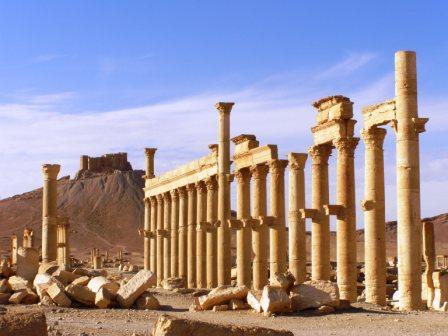
We took a drive out into the Syrian desert to visit Palmyra, an oasis and the site of a city of Roman ruins.This is what Felix found out about Palmyra:
Palmyra
Palmyra was a settlement in prehistoric times because it was an oasis. There are traces of buildings 5 thousand years old. The old name of Palmyra was Tadmor which was already known to the Assyrians. It was then occupied by the Greeks, and finally the Romans. In the 2nd century A.D. Palmyra traded all the way to China and Italy. All the major temples of Palmyra where enlarged. Palmyra expanded and became one of the great cities of the orient .
The most famous ruler of Palmyra was the warrior queen Zenobia. She was an ambitious and courageous queen. She spoke Aramaean as well as Greek and Egyptian and claimed to be a descendant of Queen Cleopatra. Dressed in purple with a helmet on her head, she would address a crowd as would an Emperor. She had pale skin, black eyes and beautiful teeth, as white as pearls. Zenobia’s son became the heir to the throne when he was very young, so Zenobia proclaimed herself queen and declared her independence from Rome. Aurelian, the Roman Emperor at the time, attacked Palmyra.
First, Aurelian fought the Palmyrenes on the plain of Emesa and defeated them, so they withdrew to Palmyra. It took a week for Aurelian to get there through the desert, being attacked by Bedouins. His Army laid siege to the fortified city of Palmyra. After weeks of fighting, Queen Zenobia was escorted on a camel, as she went to her ally Sapor. She was captured by Aurelian’s horsemen when she was about to cross the Euphrates and Palmyra was overtaken.
Palmyra became Christian during the 4th century, and Muslim during the 7th century. Its temples where converted to Churches then Mosques. During the Ottoman Empire Palmyra declined, but in the last 50 years it has become once again an important oasis, and one of the most important tourism site in the Middle East.
My visit to Palmyra:
We went inside the temple of Bel, where they made animal sacrifices to the gods. There was a path with seats on either side where they lead the animals in a great procession to the temple. In the museum we saw some clay tokens that were used as tickets for spectators to see the sacrifices. There was a roman theatre and walkways lined on either side by columns holding up a roof. Inside and outside these walkways, we saw ruins of shops and houses. We went to the valley of tombs where we went inside one. There were shelves to keep the coffins in. One tomb tower could hold about 70 coffins.
 |
| Bedouin camps on the way to Palmyra |
 |
| Camels |
 |
| Desert |
 |
| Model of the temple of Bel |
 |
| The central part of the Temple of Bel, where animal sacrifices were held. |
 |
| Roman columns |
 |
| These columns are what's left of the perimeter of the Temple of Bel, as seen in the model above. |
 |
| Dani and Nonno checking out the carvings |
 |
| The Cardo in Palmyra - Roman cities have in common a long central main street called the Cardo, lined with columns. The one in Palmyra is very long, with many columns still standing |
 |
| Tai and Barney riding camels - Felix wasn't game yet. The backdrop to the Roman ruins is a craggy castle, built by Muslim rulers after the Romans, sitting on a high hill. |
 |
| Intricate carvings on a coffin |
 |
| View of the Palmyra ruins from the castle |
 |
| Inside the castle. Palmyra is in the background, with the Cardo leading away from the castle toward the Temple of Bel at the rear. You can see the green of the oasis that provided the reason for Palmyra being there. |
 |
Tomb towers of Palmyra
|
 |
| This is what the tombs look like close-up (except they're not sideways in real life (can't quite work that out)) |
 |
| Inside the towers is places to park a coffin, room for up to 100 |
|
|
 |
| Bedouin woman with tribal tattoos |
 |
| Bedouin camp spotted beside the road on the way home |
 |
Dates were in season in Palmyra, with differen varieties hanging up outside the shops: yummy
|